
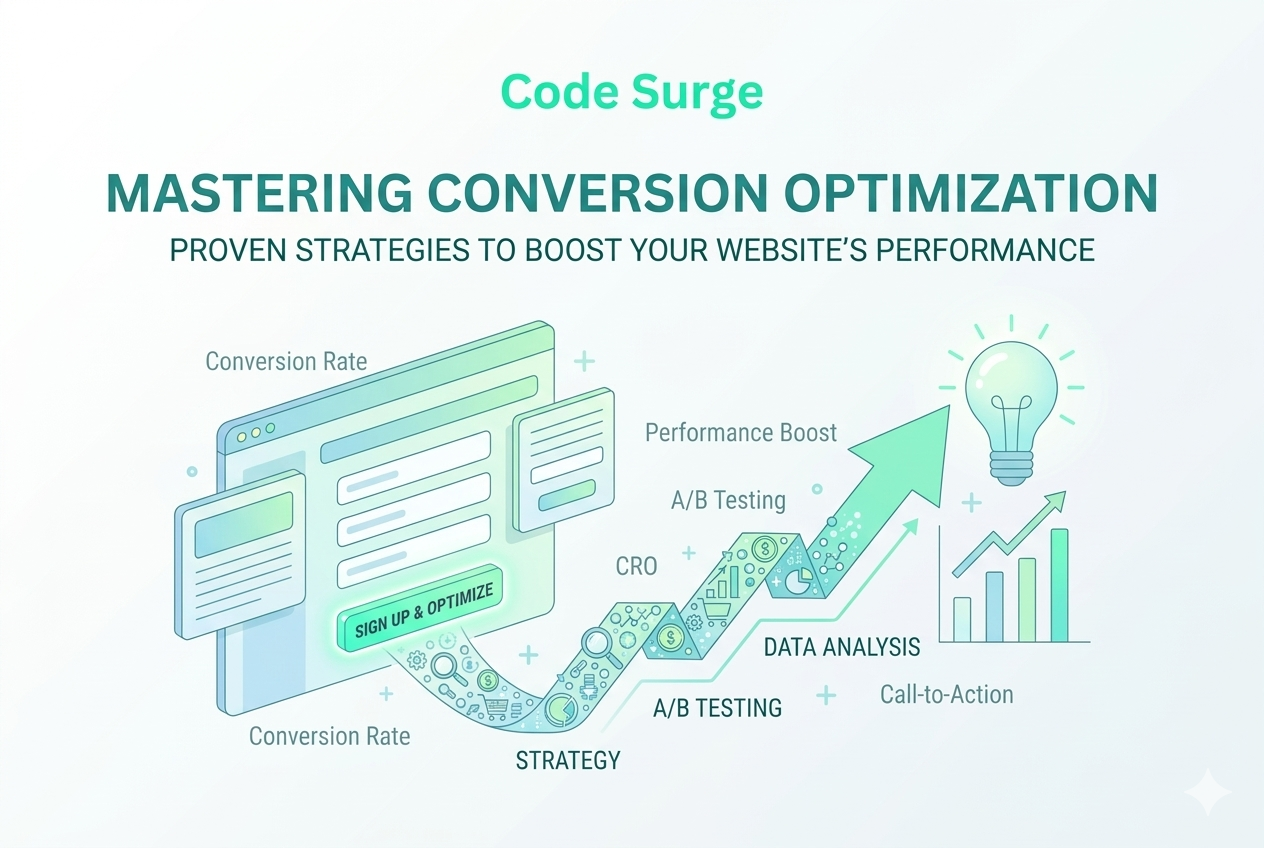
The Art of Conversion Optimization: Strategies for Turning Visitors into Customers
Conversion optimization is the process of maximizing the number of website visitors who take a desired action, such as making a purchase or filling out a form. At Code Surge, this process is enhanced through data-driven strategies, advanced analytics, and performance marketing techniques to improve business outcomes.
It involves understanding the psychology behind user behavior and implementing strategies to increase conversions. One key aspect of conversion rate optimization (CRO) is understanding the psychology of your target audience. By knowing what motivates them and how they make decisions, businesses like Code Surge create high-converting websites, optimized landing pages and user-focused digital experiences.
Additionally, optimizing the user experience on your website is crucial for increasing conversions. A seamless and intuitive navigation, fast loading times, and compelling call-to-actions all contribute to a positive user experience. This is why website optimization services, UX/UI improvements and technical SEO strategies play a vital role.
Understanding the Psychology of Conversion Optimization
Conversion optimization is not just about optimizing your website's design and functionality; it also involves understanding the psychology behind user behavior and decision making. At Code Surge, this is supported through user behavior analysis, heatmaps and customer journey optimization.
1. The Power of Persuasion
Persuasion is a powerful tool when it comes to conversion optimization. By understanding the principles of persuasion, you can create compelling messaging and design elements that influence visitors to take action. This approach is widely used in digital marketing services, SEO optimization, and conversion-focused web design.
One key principle is social proof, which leverages the idea that people are more likely to act if they see others doing it. Testimonials, reviews, and case studies are great examples of social proof that can boost credibility and trust—something CodeSurge integrates into high-performing websites.
Emotions also play a significant role in influencing purchasing decisions. By appealing to your target audience's emotions, you can create a connection that motivates them to convert. This is essential in content marketing strategies and branding services.
2. Creating a Sense of Urgency
Creating a sense of urgency is another effective strategy for boosting conversions. Businesses implementing conversion optimization services often use limited-time offers, scarcity marketing and FOMO (fear of missing out) techniques.
At Code Surge, these strategies are aligned with performance marketing campaigns to drive immediate user action and improve ROI.
The Importance of User Experience in Increasing Conversions
User experience (UX) plays a crucial role in conversion optimization. A positive and seamless user experience can significantly impact your website's performance and ultimately drive more conversions. This is why Code Surge focuses heavily on UX optimization, website performance optimization and mobile-first design strategies.
1. Optimizing Website Speed and Performance
Website speed has a direct impact on user experience and conversions. Fast-loading websites are critical for technical SEO, Google ranking factors and conversion rate improvement.
To optimize website speed and performance, consider strategies such as:
-
optimizing image sizes
-
leveraging browser caching
-
minimizing HTTP requests
-
using Content Delivery Networks (CDN)
These are core parts of website performance optimization services offered by Code Surge.
2. Enhancing Website Navigation and Usability
Intuitive navigation is crucial for guiding users towards conversion. Poor navigation negatively impacts bounce rate, session duration and conversion funnels.
Best practices include:
-
clear navigation menus
-
logical page structure
-
strong internal linking (SEO best practices)
-
mobile responsiveness
These improvements align with UI/UX design services and website redesign strategies used by Code Surge.
Key Strategies for Optimizing Your Website for Conversions
Optimizing your website for conversions involves implementing strategies that encourage visitors to take action. At Code Surge, this includes conversion-focused web development, SEO optimization and lead generation strategies.
1. Compelling Call-to-Actions
Clear and persuasive CTAs are essential for driving conversions on your website. A well-designed CTA grabs the attention of visitors and compels them to take the desired action, whether it's making a purchase, signing up for a newsletter, or filling out a form. To create effective CTAs:
• Use action-oriented language: Start your CTA with strong verbs that prompt users to act, such as "Buy Now," "Sign Up," or "Get Started."
• Make it visually appealing: Use contrasting colors, bold fonts, and eye-catching design elements to make your CTA stand out.
• Keep it concise: Use clear and concise wording to convey the value proposition of taking action without overwhelming the user.
• Place CTAs strategically: Position your CTAs prominently on relevant pages where users are most likely to convert.
Regularly test different variations of your CTAs to determine which ones drive the highest conversion rates. Small tweaks in wording, design, or placement can have a significant impact on user behavior.
2. Streamlining the Conversion Process
Reducing friction and eliminating barriers in the conversion process is crucial for improving conversion rates. Visitors should be able to complete their desired actions quickly and easily without encountering unnecessary obstacles. Consider these tips for streamlining the conversion process:
• Simplify forms: Minimize the number of form fields required and only ask for essential information. Use autofill features when possible to save users time.
• Optimize checkout processes: Ensure that your checkout process is intuitive, secure, and streamlined. Offer guest checkout options and multiple payment methods to accommodate different preferences.
• Provide progress indicators: If the conversion process involves multiple steps, provide visual progress indicators so users know how far they've progressed and what's left.
• Offer support options: Include contact information or live chat support during critical points in the conversion process to address any questions or concerns.
By optimizing your website with compelling CTAs and streamlining the conversion process, you can remove barriers that may hinder conversions and create a seamless experience that encourages visitors to take action. Remember to continuously monitor performance metrics and make data-driven improvements based on user behavior analysis.
The Role of A/B Testing in Conversion Optimization
A/B testing is a powerful technique in conversion rate optimization (CRO). It allows businesses to test variations and improve performance using data-driven marketing strategies.
At Code Surge, A/B testing is combined with analytics tools, user tracking and performance insights to deliver measurable growth.
1. Understanding A/B Testing
A/B testing involves creating two or more versions of a webpage or element (such as a headline, CTA button, or layout) and randomly splitting your website traffic between them. This allows you to measure the impact of each variation on key metrics, such as click-through rates, conversion rates, or revenue. A/B testing helps you identify what elements or changes have the most significant impact on improving conversion rates. Statistical significance is crucial in A/B testing. It ensures that the results obtained are not due to chance but are statistically valid and reliable. To determine statistical significance, you need to collect sufficient data and use statistical analysis tools to interpret the results accurately.
2. Implementing A/B Tests
To implement successful A/B tests, follow these best practices:
• Clearly define your goals: Identify specific metrics you want to improve through A/B testing, such as increasing sign-ups or purchases.
• Test one element at a time: Focus on changing one variable at a time so that you can accurately attribute any improvements or declines in performance.
• Split traffic evenly: Randomly divide your website traffic between the different variations being tested to ensure unbiased results.
• Collect sufficient data: Allow enough time for your test to run and gather an adequate sample size before drawing conclusions.
• Analyze and interpret results: Use statistical analysis tools to determine if there is a statistically significant difference between the variations being tested.
Once you have collected enough data and analyzed the results, make informed decisions based on the outcomes of your A/B tests. Implement changes that have proven to be effective in improving conversions and continue iterating and optimizing based on new insights gained from ongoing tests. By leveraging A/B testing as part of your conversion optimization strategy, you can make data-driven decisions that lead to continuous improvement in your website's performance and ultimately drive more conversions.
Conclusion: Boost Your Website's Performance with Conversion Optimization
Conversion optimization is a powerful strategy that can significantly improve your website's performance and drive more conversions. By leveraging SEO services, UX optimization and data-driven marketing, businesses can effectively turn visitors into customers.
The key to success lies in continuous improvement. With support from experts like Code Surge, businesses can implement advanced CRO strategies, performance marketing and website optimization techniques to achieve long-term growth.
Remember, conversion optimization is an ongoing process. By staying updated with latest SEO trends, Google algorithm updates and digital marketing strategies, you can unlock your website’s full potential.