
When people search for products, services or businesses online, appearing in search results can make a major difference to how easily potential customers find a brand. Two of the most common strategies used to increase search visibility are Search Engine Optimization (SEO) and Search Engine Marketing (SEM).
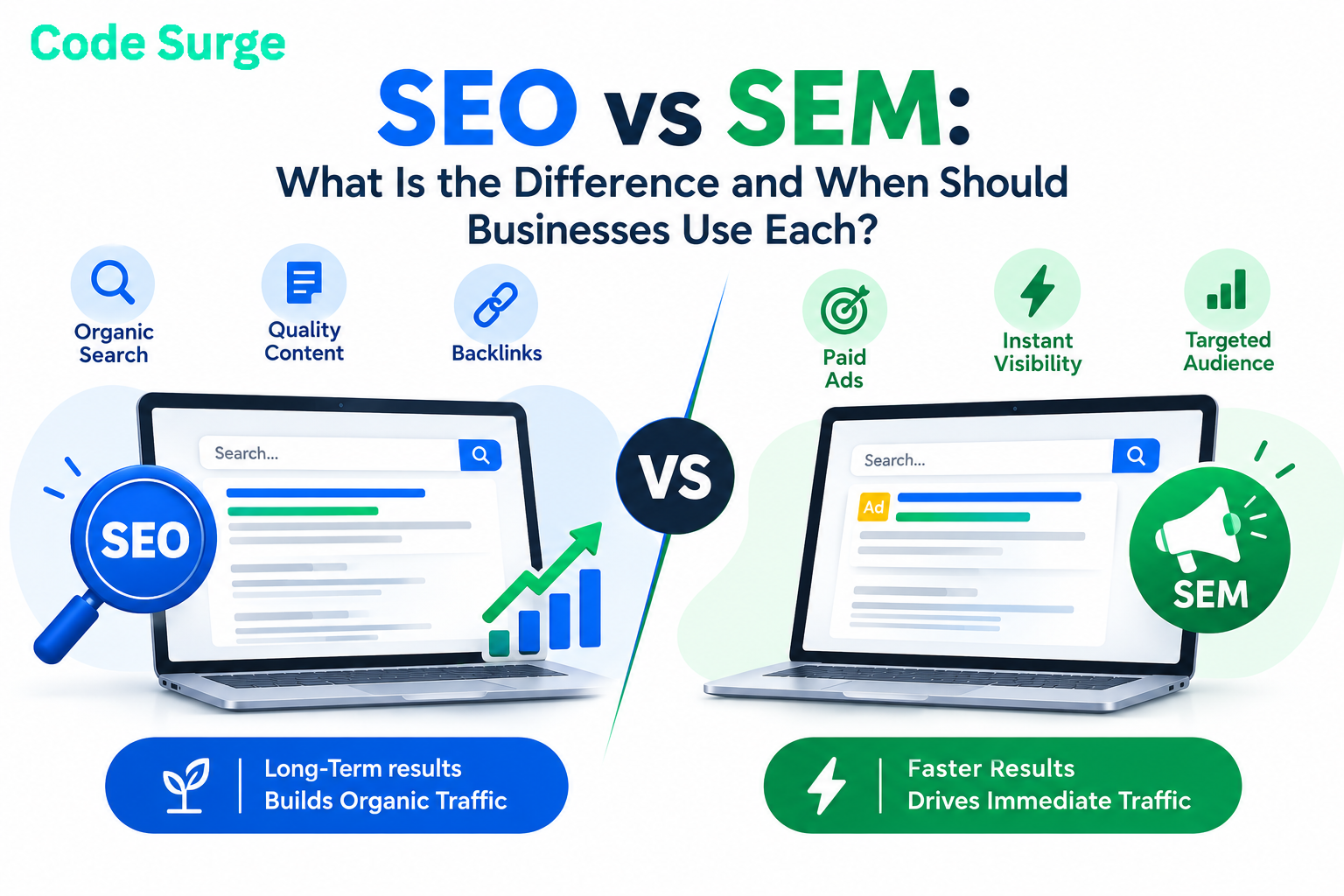
Although SEO and SEM are often used interchangeably, they are not exactly the same. SEO focuses on improving a website's visibility in organic search results, while SEM commonly refers to paid search advertising and, depending on the context, the broader practice of marketing through search engines.
So, what is the difference between SEO and SEM? Which strategy should a business use? And can SEO and SEM work together?
Let's break it down.
What Is SEO?
Search Engine Optimization (SEO) is the process of improving a website so that its pages can be discovered, understood, indexed, and shown more prominently in organic search results.
SEO does not involve paying Google for individual organic rankings. Instead, businesses improve their websites, content, technical performance, relevance, and authority to make them more useful to both search engines and users.
Google recommends creating helpful, reliable, people-first content and making it easier for search engines to crawl and understand a website.
A typical SEO strategy can include:
-
Keyword research
-
Search intent analysis
-
Technical SEO
-
On-page SEO
-
Content optimization
-
Internal linking
-
Website structure improvements
-
Local SEO
-
Image optimization
-
Website speed and performance improvements
-
Link building and digital PR
-
Google Search Console analysis
-
Organic traffic and ranking analysis
For businesses that want to build sustainable organic visibility, SEO can become an important long-term digital marketing channel.
What Is SEM?
Search Engine Marketing (SEM) is the use of search engine advertising to reach potential customers through paid placements on search results pages.
For example, a business can create paid search campaigns targeting keywords that potential customers are searching for. When users search for those terms, relevant advertisements may appear in sponsored areas of the search results.
SEM campaigns can be used to:
-
Generate website traffic
-
Increase leads
-
Promote specific products or services
-
Reach users with high purchase intent
-
Test keyword and messaging ideas
-
Support time-sensitive promotions
-
Drive conversions through targeted landing pages
Paid search can provide businesses with greater control over targeting, budget, ad messaging, and campaign timing compared with organic search.
SEO vs SEM: What's the Difference?
The simplest way to understand the difference is:
SEO focuses on earning organic visibility, while SEM focuses on paid visibility through search advertising.
However, there are several practical differences between the two.
|
Factor |
SEO |
SEM |
|
Main focus |
Organic search visibility |
Paid search visibility |
|
Traffic type |
Organic |
Paid |
|
Payment model |
No payment for individual organic clicks |
Usually paid advertising |
|
Time to see results |
Usually takes time |
Can generate traffic soon after campaigns launch |
|
Long-term value |
Can continue generating organic traffic after work is completed |
Traffic generally depends on an active advertising budget |
|
Keyword targeting |
Based on relevance, content, authority and search intent |
Based on campaign targeting and advertising settings |
|
Main activities |
Technical SEO, content, links, on-page optimization |
Ads, bidding, targeting, landing pages and campaign optimization |
|
Best suited for |
Long-term organic visibility |
Immediate or targeted search campaigns |
The distinction is important because SEO and SEM require different approaches, budgets, measurement methods, and expectations.
SEO vs PPC: Are They the Same?
Another common question is whether SEO and PPC are the same.
They are not.
SEO focuses on organic search results, while PPC (Pay-Per-Click) is a paid advertising model where advertisers generally pay when someone clicks an advertisement.
Search advertising is one component of paid search marketing. SEO, on the other hand, is focused on improving a website's organic search presence.
This means a business can use:
-
SEO without PPC
-
PPC without a major SEO campaign
-
Or both together
The right combination depends on the company's goals, budget, competition, website, and target audience.
How Does SEO Help a Business?
SEO can help businesses build visibility for searches related to their products, services, problems, and industry.
For example, a Sri Lankan technology company could target searches related to:
-
Web development services
-
E-commerce development
-
SEO services
-
Mobile app development
-
Software development
-
IT consulting
-
Search engine optimization
-
Digital marketing services
Instead of paying for every visitor, the goal of SEO is to build organic visibility for relevant searches over time.
SEO can also help businesses reach users at different stages of the buying journey.
Someone may first search:
"What is e-commerce development?"
Later, they might search:
"Best e-commerce development company in Sri Lanka"
And eventually:
"E-commerce development company Sri Lanka"
A strong SEO strategy can create useful content and service pages that address these different search intents.
How Does SEM Help a Business?
SEM can help businesses reach searchers who are actively looking for particular products or services.
For example, a company offering web development could create paid campaigns around relevant commercial keywords. A user searching for a service may then see the company's advertisement near the top of the search results.
SEM can be particularly useful when a business wants to:
-
Generate traffic quickly
-
Promote a new service
-
Support a product launch
-
Generate leads for high-value services
-
Target specific commercial keywords
-
Test different advertising messages
-
Reach customers in specific locations
However, paid search requires ongoing campaign management. Businesses need to monitor spending, keyword performance, conversion rates, landing pages, and return on advertising spend.
SEO vs SEM: Which One Should a Business Use?
There is no single strategy that works for every business.
The right approach depends on what the business is trying to achieve.
Choose SEO when your goal is long-term organic visibility
SEO may be a suitable priority if you want to:
-
Increase organic search traffic
-
Build search visibility around important topics
-
Create long-term content assets
-
Improve rankings for commercial keywords
-
Build authority in your industry
-
Reduce dependence on paid traffic over time
SEO usually requires patience. Google notes that changes can take anywhere from hours to several months to show an impact, depending on the change and circumstances.
Consider SEM when you need targeted paid traffic
SEM may be useful when you want to:
-
Generate traffic quickly
-
Promote specific services
-
Reach users searching for high-intent keywords
-
Run a time-sensitive campaign
-
Test different offers and messages
-
Control advertising budgets and targeting
Paid search can complement SEO when organic rankings are still developing.
Can SEO and SEM Work Together?
Yes.
In many cases, SEO and SEM can complement each other instead of being treated as competing strategies.
For example, imagine a business wants to increase leads for a particular service.
The business could use SEM to generate targeted paid traffic while the SEO team works on improving the relevant service page, creating supporting content, building internal links, and increasing organic visibility.
Over time, the business can use data from both channels to understand:
-
Which keywords attract potential customers
-
Which landing pages generate conversions
-
Which search queries have commercial intent
-
Which messages attract clicks
-
Which services generate the most leads
-
Where organic visibility can be improved
This creates a more complete search marketing strategy.
SEO and SEM for Businesses in Sri Lanka
For Sri Lankan businesses, search visibility can be particularly valuable when customers already use Google to research services before making a decision.
Depending on the business model, a search strategy may target:
-
Sri Lanka-wide searches
-
Colombo and other local areas
-
Specific industries
-
Service-based searches
-
Product-related searches
-
B2B searches
-
International customers
The important part is understanding who the target customer is, what they search for, and what they expect to find after clicking a result.
Instead of simply targeting high-volume keywords, businesses should also consider search intent, relevance, competition, and conversion potential.
How to Build an SEO and SEM Strategy
A practical search marketing strategy can start with these steps.
1. Define your business goals
Decide whether your priority is:
-
Brand awareness
-
Website traffic
-
Leads
-
Sales
-
App downloads
-
Online enquiries
-
Local visibility
2. Research your target keywords
Identify the searches your potential customers use.
Separate keywords into categories such as:
-
Informational keywords
-
Commercial investigation keywords
-
Transactional keywords
-
Local keywords
-
Branded keywords
3. Improve your website
Your website should clearly communicate what you offer and make it easy for users to take the next step.
SEO also involves helping search engines discover and understand your pages. Google recommends crawlable links, descriptive anchor text, logical site organization, and useful content.
4. Create useful content
Create content that genuinely answers your audience's questions rather than writing articles only to insert keywords.
For example, a technology company could create content around:
-
Web development
-
E-commerce
-
SEO
-
Mobile applications
-
UI/UX
-
Cloud solutions
-
IT consulting
-
Digital marketing
Each topic can then support relevant service pages through contextual internal links.
5. Measure performance
Use tools such as Google Analytics and Google Search Console to monitor organic traffic, search queries, impressions, clicks, conversions, and landing-page performance.
For paid campaigns, monitor metrics such as:
-
Click-through rate
-
Cost per click
-
Conversion rate
-
Cost per conversion
-
Conversion value
-
Return on ad spend
The data can then be used to improve both organic and paid search strategies.
Why Internal Linking Matters for SEO
Internal linking is an important part of a well-structured website.
For example, this article can link readers to Code Surge's Search Engine Marketing services when they want to explore professional SEM support.
You can also explore the Code Surge to learn more about the company's technology and digital services.
For readers interested in the company's background, the About Code Surge page provides more information about the business.
Businesses interested in technology solutions can also explore Code Tech to learn more about the technology-focused side of Code Surge.
And if you want to explore more topics around technology, SEO and digital marketing, visit the Code Surge blog.
For businesses that want to discuss their requirements directly, the Code Surge contact provides a way to get in touch.
These links are useful because they connect related pages and help both users and search engines understand how different parts of a website relate to each other. Google specifically recommends relevant internal links and descriptive anchor text.
Frequently Asked Questions About SEO vs SEM
Is SEO better than SEM?
SEO and SEM serve different purposes. SEO focuses on organic search visibility, while SEM focuses on paid search visibility. The appropriate approach depends on the business's goals, budget, competition, and timeline.
What is the main difference between SEO and SEM?
The main difference is how search visibility is obtained. SEO focuses on improving organic rankings and visibility, while SEM commonly refers to paid search advertising.
Is SEO cheaper than SEM?
SEO does not require paying Google for individual organic clicks, but it still requires investment in strategy, content, technical improvements, tools, and expertise. SEM requires an advertising budget as well as campaign management.
How long does SEO take to work?
SEO results vary significantly depending on the website, competition, industry, technical condition, content quality, authority, and the changes being implemented. Some changes can be reflected relatively quickly, while meaningful organic growth can take considerably longer.
Can I use SEO and SEM at the same time?
Yes. Businesses can use SEO to develop long-term organic visibility while using paid search campaigns to reach targeted audiences and generate traffic or leads.
Is SEM the same as Google Ads?
Not necessarily. Google Ads is Google's advertising platform, while SEM is a broader term commonly used for marketing through search engines, particularly paid search advertising. The exact definition of SEM can vary across the industry.
Which keywords should I target for SEO and SEM?
Start with keywords that closely match your products or services and the intent of your target customers. Consider search volume, competition, relevance, commercial intent, location, and conversion potential rather than focusing only on search volume.
Final Thoughts
SEO and SEM are two different approaches to gaining visibility in search engines, but they can work together as part of a broader search marketing strategy.
SEO is focused on building organic visibility and long-term search presence, while SEM can help businesses reach targeted users through paid search campaigns.
For a business deciding where to invest, the key questions are not simply "SEO or SEM?" but:
-
What are our business goals?
-
How quickly do we need results?
-
Which keywords are valuable to our customers?
-
What is our available budget?
-
How competitive is our market?
-
Which channels are already generating leads?
-
Can our website convert the traffic we generate?
By answering these questions and measuring performance consistently, businesses can build a search strategy based on data rather than choosing a channel simply because it is popular.
If you are looking to improve your search visibility, explore Code Surge's Search Engine Marketing services or contact Code Surge to discuss your business requirements.